Creating in the dark is killing your growth. It’s also burning you out, and those aren’t two problems. It’s one problem showing up twice.
You post and you don’t know if it worked, so you post again. Do that for a few months and it stops being creating and starts being guessing, and guessing is what wears you down.
A new Compound to 30™ member joined two months ago. In our 1:1 onboarding audit she told me one of her biggest frustrations: she was posting daily and seeing barely any growth. That’s 36 posts a week on multiple platforms (like Gary V said), over 4 months, and she couldn’t name one specific post that had moved the needle. The views and likes were fine, but subscribers were flat.
So we pulled her last 30 posts and ranked them by engagement data. 6 of them had brought almost every new subscriber she’d had. Same effort, completely different picture, and now she writes more of those and fewer of the rest.
The work was fine. She just couldn’t see it.
Most creators aren’t short on ideas. They’re short on feedback. They make things every week, sometimes every day, and get almost nothing back they can use. A few likes, a comment from the same three people, a number that went up or didn’t with no way to tell why.
So this issue fixes that. Three pains, a fix for each, then a loop that ties them together and one leak to plug this week.
01.The Burnout Nobody Names Properly
When creators burn out, the usual diagnosis is volume. Too many posts, too many platforms, not enough hours. And volume is part of it.
But think about the posts that didn’t drain you. The ones where you knew what you were making, who it was for, and roughly how it would land. Same effort. Different feeling.
The drain is the doubt on top of the work. Every time you hit publish, three questions come with it: what should I post, when should I post it, did that one work? If you can’t answer them you go on gut, every day, on every platform, and that’s hundreds of small decisions a month with nothing behind them. That’s what content burnout mostly is. Not the making. The not-knowing.
Now the other side of it, growth. If you can’t see what’s working, you can’t do more of it, so you repeat what felt good instead of what performed. Weeks pass, the numbers sit flat, and flat numbers make you doubt more.
That’s why I say it’s one problem. The same missing information is draining your energy and stalling your growth.
02.What Most People Do About It, and Why It Keeps Failing
There are four common responses, and I’ve seen all of them.
- Post more. If one in ten lands, post twenty. But more volume without feedback is just more guessing, faster. You burn out sooner and learn nothing extra.
- Stay consistent. Good advice, and only half the answer. Consistency on the wrong thing is a reliable way to get the same flat result.
- Copy the big accounts. Their audience isn’t yours, their history isn’t yours, and what works at 200,000 followers often doesn’t at 2,000. You copy the output and miss the context.
- Look up the best time to post. Those articles average thousands of audiences you don’t have. Your readers might be reading at 7am or scrolling at 10pm. A generic answer won’t tell you.
Every one of these keeps you busy without giving you any data, so none of them fix it.
03.Pain 1: “I Don’t Know What to Post”
This is the Sunday-evening pain. You sit down, open a blank page, and wait for an idea that feels safe.
The fix is to stop starting from a blank page and start from your own results. Your audience has already told you what they want. You just haven’t been reading it properly.
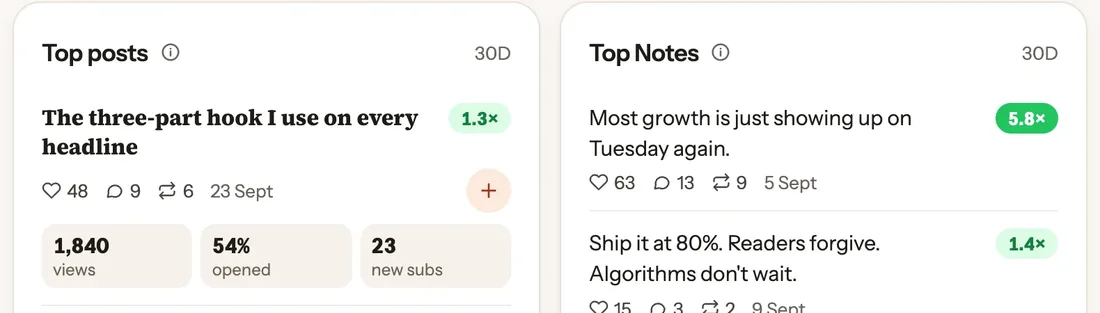
Most people look at likes. Likes are the cheapest signal there is, because a like costs a tap. Look at saves, replies, shares, and above all, which posts brought you new followers or subscribers. Those cost the reader something. A save means “I want this again.” A reply means “this hit a nerve.” A new subscriber means “I want more from this person.”
So pull your last ten or twenty posts, rank them by those signals, and write down what the top ones have in common. The topic, the format, the opening line. You’ll usually spot a pattern within a few minutes, and that pattern is your next month of ideas.
04.Pain 2: “I Don’t Know When to Post”
Same story. You’re guessing at a time, usually the one some article handed you.
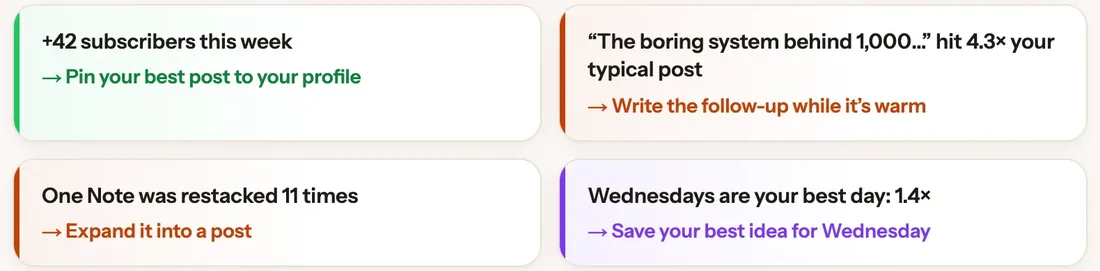
The fix is to find your audience’s pattern instead of the average one. Take the same set of posts and note when each one went out against how it performed. Don’t read too much into a single post, but across twenty you’ll often see a couple of slots that keep winning and a couple that keep falling flat.
Then test it. Pick two time slots, post comparable content in each for four weeks, and compare. It’s not complicated. It just needs the numbers in one place, so you aren’t scrolling back through three apps to piece it together.
05.Pain 3: “I Can’t Tell What’s Working and What’s Not”
This is the big one, because it sits underneath the other two. If you can’t tell what’s working, you can’t choose what to post or when.
Two things fix it.
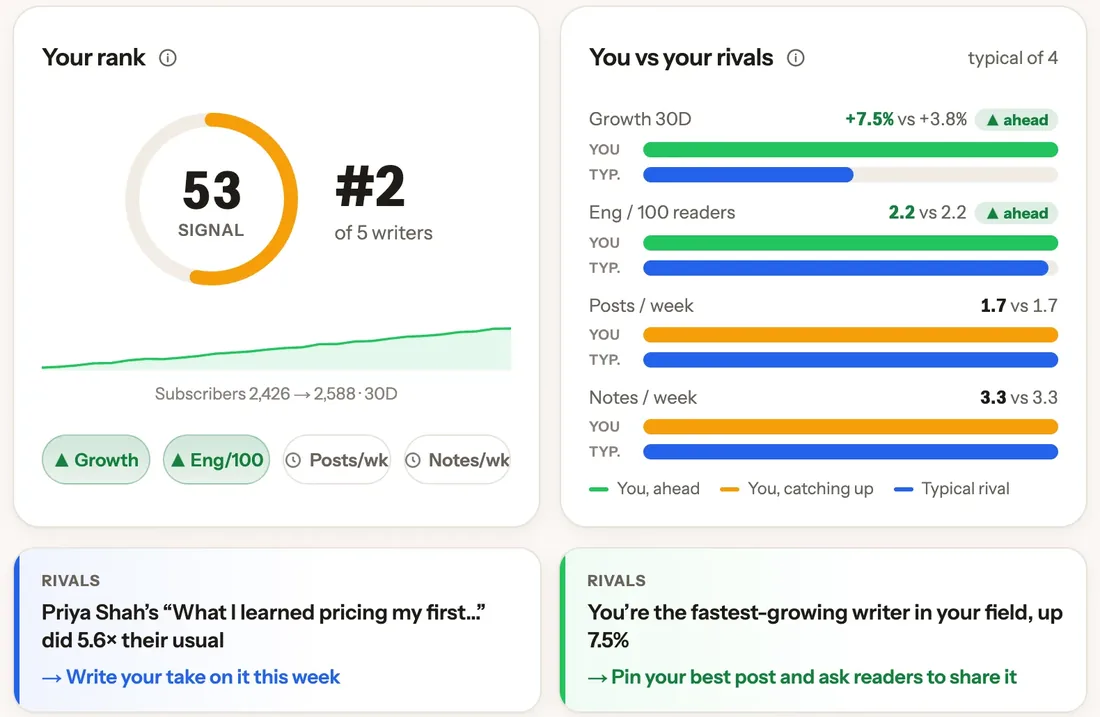
First, pick one real number per platform and check it once a week. Not impressions, and not follower count on its own. The number that connects to your business: new subscribers, replies, clicks to your offer. One number is something you’ll actually look at. Fifteen numbers is a dashboard you open once and never again.
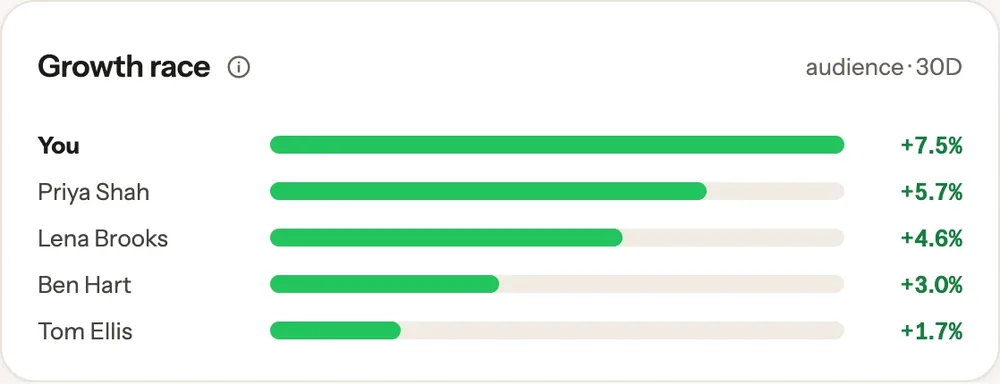
Second, look sideways. Check what’s working for other creators in your niche, at around your size, right now. This isn’t about copying. It’s about seeing what your shared audience is rewarding this month. And compare on rates, not raw size. A small account with a high engagement rate is telling you something useful that a big account’s raw numbers would hide.
Enjoying this? Get the next one free.
No-Fluff Friday lands every Friday — one practical system to build your backend and take back your time. No fluff, unsubscribe anytime.
06.Put the Three Together and You’ve Built a Loop
Look at what worked. Learn the pattern. Lean into it with the next few posts. Look again.
That’s the whole thing. It takes about twenty minutes a week once it’s set up, and it changes how posting feels. You stop asking “what if this flops?” and start asking “what does the data say about this one?” One of those wears you out. The other one compounds.
07.What Changes When You Can See
Nothing about your workload has to change. Same number of posts, same hours.
What changes is the Sunday evening. You sit down already knowing which topics your audience saves. You schedule for the times your readers actually show up. On Friday you check one number and know whether the week worked, instead of refreshing a feed and hoping.
The work is the same. The doubt is gone, and the doubt was the heavy part.
There’s a second change, and it shows up a few weeks in. You stop taking a flat week personally. A post that misses becomes a data point instead of a verdict on you. You note it, you check whether it fits a pattern, and you move on. That sounds small, but it’s the difference between a creator who keeps going for a year and one who quietly stops in month three because every miss felt like proof that nothing works.
And when something does land, you know why, so you can do it again on purpose.
08.Why Smaller Accounts Need This More
If you have 500 followers, you can’t afford to waste posts. A big account can have a bad week and nobody notices. When you’re small, a run of posts that miss costs you weeks of momentum, and momentum is hard to rebuild when the audience is still deciding whether to stick around.
So the smaller you are, the more every post has to count, and the more it matters that you know what counts. This is also where a small account has an edge. You can change direction fast, and nobody is expecting you to keep posting what used to work.
09.Three Mistakes When You Start Reading Your Numbers
- Reacting to one post. One post is noise. Ten is a pattern. Make decisions on patterns.
- Tracking everything. Pick one number. Add a second only when the first has become a habit.
- Comparing yourself to accounts ten times your size. Compare to your own last month, and to creators around your level. That’s the comparison that tells you something you can act on.
10.“But Data Will Kill My Creativity”
I hear this one a lot, and I get it. Nobody started creating so they could stare at a spreadsheet.
But look at what the data is actually doing. It isn’t telling you what to say. It’s telling you which of the things you already wanted to say got a response. The ideas are still yours, the voice is still yours, and the writing is still yours. You’re just no longer posting every idea and hoping.
If anything, it frees up creative energy. When you’re not burning half your mental effort on “is this the right thing to post?”, you’ve got more left for making the thing good.
11.“But I Don’t Have Time for This”
Fair, and this is why the loop has to stay small. Twenty minutes a week. One number per platform. Ten posts, not a hundred.
Compare that with how much time you spend now, staring at a blank page, second-guessing a draft, and checking whether a post has moved. That time already exists. It’s just going into worry instead of into information.
12.One Leak to Plug This Week
🔧 One Leak to Plug This Week
The leak: you’re choosing what to post by feel.
The fix, about 20 minutes:
- Open your last ten posts on your main platform.
- Rank them by saves and replies, not likes.
- Find what your top two have in common: the topic, the format, or the opening line.
- Make your next three posts lean into that.
- Write down the result next Friday.
If those 3 beat your average, you’ve just proved the loop works for you. If they don’t, you’ve still learned something real, which is more than guessing ever gave you.
13.Where I’d Point You Next
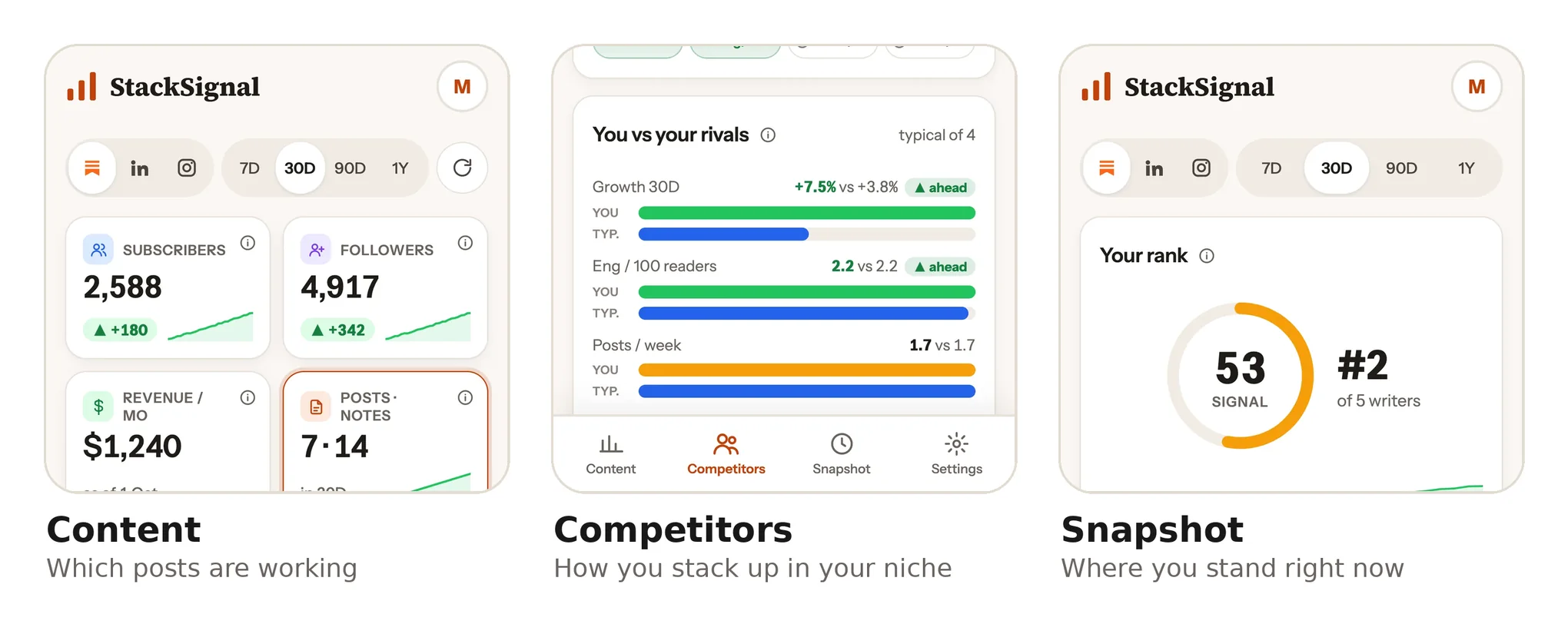
Doing all of this by hand across Substack, LinkedIn and Instagram means a lot of tabs and a lot of copying numbers into spreadsheets. Most people try it for a week and drop it. That’s the reason I built StackSignal.
StackSignal pulls your Substack, LinkedIn and Instagram numbers into one place, in three tabs. Content shows which of your posts are performing. Competitors shows what’s working for creators in your niche. Snapshot shows where you stand right now. It’s everything we just covered, without the spreadsheets.
Open your Dashboard → Setup in 2 min
And if you’d rather do it by hand first, the leak above is enough to start. Either way, stop creating in the dark.